 |
|
May 13, 2026


ASPANet.org | PA TIMES.org | Donate: Campaign 2030
|

|
|
Celebrating Public Service Recognition Week
 National Public Service Recognition Week (PSRW), an annual opportunity across the United States to pay tribute to public service employees, officially took place last week. Some ASPA Chapters and Sections held events; others are scheduled during the rest of this month.
Thank you to the following ASPA groups for honoring public servants in your communities:
Events held week of May 3 or prior:
- Greater Chicago Chapter (April 24): Annual Public Service Award Ceremony
- Western New York Chapter (April 25): PSRW Conference
- Southern California Chapter (April 30): Awards Event
- New York Metro Chapter (May 5): Educational Event: "The Crisis in American Federalism"
- Joint Webinar Hosted by ASPA's Research Triangle Chapter with SNAPS, LGBT Advocacy Alliance, Arkansas Chapter and others (May 5)
- Central Virginia Chapter (May 6): Public Service Event
- Sacramento Chapter (May 6): Awards Dinner
- Evergreen Chapter (May 7): Awards Event
Upcoming events:
- New Jersey Chapter (May 13): Annual Public Service Awards Ceremony
- Utah Chapter (May 20): Public Service Awards Ceremony
- Hampton Roads Chapter (May 21): Annual Awards Luncheon
- Detroit Metro Chapter (June 9): Public Service Awards Ceremony
If your Chapter or Section event is not listed, please let us know so we can share details with the ASPA community. If you do not currently belong to a Chapter, please contact the above groups to find out how you can participate in their celebrations.
 The ASPA national office celebrated with some fun of our own! Several of us headed to the Washington, DC, Federal Center metro stop last Tuesday and handed out ASPA goodie bags to federal employees as they were starting their day at one of the many agency buildings in that area of the city. We had a good time helping make others' day brighter—and showing off some ASPA branding at the same time!
The official week may be over, but that doesn't mean it's too late to celebrate. Take a moment any time this month to show the hard-working public servants in your community that you value them.
For the public servants reading this message: Happy PSRW! The American Society for Public Administration appreciates you; thank you for your service.

ASPA Critical Take-Aways Online—and Open Source!
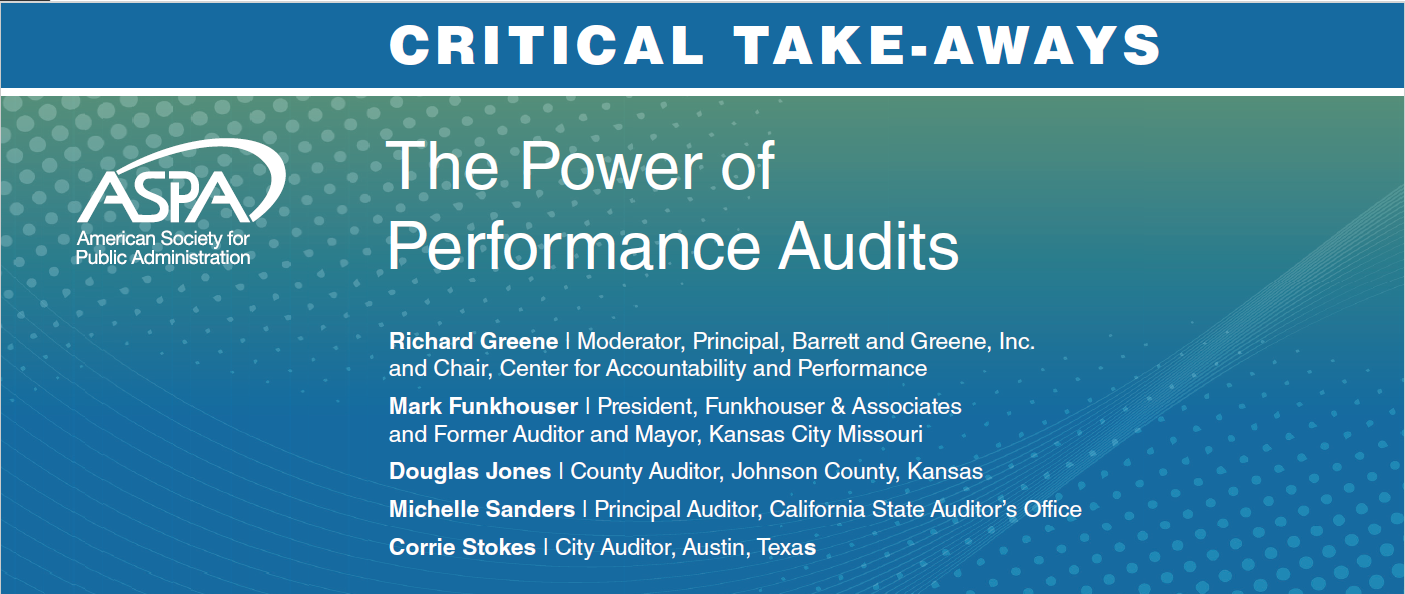 Earlier this year, ASPA launched a new publication series, Critical Take-Aways, designed to help practitioners, scholars and students stay informed and engaged on the most important issues for our profession.
Each edition offers insights into a recent ASPA e-learning program: what it covered, why it matters and how it relates to the public service community. Whether you're familiar with the topic or looking to learn more, Critical Take-Aways offers a quick starting point and a link to the full webinar on ASPA's website.
Three programs are available now:
- The Power of Performance Audits
- Navigating the New Intergovernmental Relationship
- From the Heritage Foundation to the White House: Project 2025 in Practice
More editions will be released in the months ahead. Check out the details on our website now and make the most of these open resources.


Voices of ASPA 2026
 Voices of ASPA 2026, an eight-video series showcasing individuals who shared their expertise at ASPA's 2026 Annual Conference, continues to be published via the Barrett and Greene website. Each of these experts took a few minutes to chat about ASPA and public administration; we are grateful to them for their time and to Barrett and Greene for the efforts they have put into publishing the series.
Interviews include:
- Haldane Davies
- Josh Diosomito
- Ian Elliott
- Juliette Kayyem
- Valerie Lemmie
- Debbie Trueblood
Two final videos are scheduled for release soon. If you missed hearing from any of these experts at the conference, make sure you listen to their videos!
In Memoriam: Cheryl King
 Long-time ASPA member Cheryl Simrell King has passed away; she died in early April.
King joined ASPA in the late 1990s. She was active in a number of ASPA Sections and Chapters including the Section on Public Administration Research, the Section on Historic, Artistic and Reflective Expression, the Section for Women in Public Administration, the Section on Democracy and Social Justice, the Akron, Ohio Chapter and the Evergreen Chapter. She attended ASPA's annual conferences regularly until recently, served on numerous program committees and served as an elected National Council member earlier in her membership. She delivered the 2012 Donald C. Stone Lecture with Cam Stivers through some difficult circumstances (hybrid learning before we knew it as such!).
King was on faculty at Evergreen State College starting in 2000, retiring in 2020 but staying on faculty (emerita) for several more years while also consulting for the Athena Group for a short time. She also taught at University of Akron for several years in the 1990s.
She co-authored the text, Government Is Us in 1998, which has enjoyed several editions since, as well as numerous books and articles across public administration journals.
King received her BA from the University of Texas, Permian Basin and her MPA and PhD from University of Colorado Denver.
King was a brilliant teacher and leader. She will be missed.
In Memoriam: Patricia Florestano
 ASPA is sad to announce that life-member Patricia Florestano passed away earlier this month. She was 90 years old.
In addition to her decades-long ASPA membership, which began in the 1970s, Florestano was a long-time member of the Section on Intergovernmental Administration and Management, the Section on Public Administration Education, the Suncoast Chapter, the National Capital Area Chapter and the Maryland Chapter. She served on numerous national-level committees including the Endowment Board, the National Council, awards committees, conference committees and more. She attended ASPA's annual conferences regularly and provided generous financial support to the Society.
Born in 1936 in Washington, DC, Florestano's parents were both public servants: Her father was a Washington police officer who later joined the White House Police and her mother worked for the U.S. Department of the Treasury. After high school, Florestano joined the stenographic pool at Walter Reed Army Medical Center before beginning college. She earned three degrees from the University of Maryland (UMD): a BA in 1958, an MA in American civilization in 1970 and a PhD in government and politics in 1974. She and her husband, Tom Florestano, met at UMD as undergraduates and married in 1959; they had two children before Florestano began work on her master's degree in 1964. During her doctoral work, she served as Professor Parris Glendening's graduate assistant.
Among her many career accomplishments, Florestano worked for the UMD alumni office and served a fellowship with then-State Sen. Steny Hoyer (1963). She forged a distinguished career in teaching, administration and public service. She was a faculty member at UMD and University of Baltimore, focusing her teaching on urban studies. She served as director of the University of Maryland Institute for Governmental Service from 1979 to 1984. She became vice president for governmental relations for University System of Maryland (USM) in 1985—a position she held for several years. She was a senior research fellow at the Schaefer Center for Public Policy from 1994-1995. She joined the campaign team that elected Parris Glendening to governor in the 1990s and then was appointed as the state's secretary of higher education during his term.
Her dedication to the state and its higher education institutions included 14 years of service on the USM Board of Regents, including as its chair, during her retirement years. She was a fellow of the National Academy of Public Administration.
Visitation will be held at John M. Taylor Funeral Home, 147 Duke of Gloucester Street, Annapolis, Maryland on Tuesday, June 16, 2026, from 2 to 4 and 6 to 8 pm. A Mass of Christian Burial in St. Mary's Catholic Church, 109 Duke of Gloucester Street, Annapolis, MD 21401 on Wednesday, June 17, 2026, at 10:30 a.m. In lieu of flowers, donations may be made to the Patricia S. Florestano Scholarship at the University of Maryland. An online guest book is available here.
You can find her full obituary online here.
National Civic League: CyberSim and Take9 for Civic Digital Resilience
The National Civic League recently launched CyberSim and Take9 for Civic Digital Resilience, a new initiative using interactive simulations to help local governments better understand and prepare for cybersecurity threats. They soon will be inviting communities to sign up as pilot communities for a free CyberSim implementation, but first they are following up on a fact-finding survey with two focus groups to go deeper. To ensure the scenarios in the pilot simulations reflect the real challenges local governments face, the League is hosting two virtual focus groups this May: May 19 at 2:00 p.m. ET and May 21 at Noon ET. Local government officials' first-hand experience is exactly what they’re looking for. Sessions are open to any local government staff or leader—no cybersecurity expertise required.
What to Expect
A facilitated conversation about real-world cybersecurity challenges, your community's response capacity and what meaningful preparedness looks like on the ground. Expect an engaging, peer-level discussion, not a technical briefing.
Why It's Worth Your Hour
Participants will receive first priority consideration when communities are selected for individual CyberSim pilot simulations, a free, hands-on experience to strengthen your digital security preparedness.
Can't make either session but still interested in a free pilot simulation for your community? Email Rebecca Trout.
IRSPM Forum: Slow Science in Public Management Research
IRSPM is pleased to launch the IRSPM Online Fora, a new initiative aimed at creating a space for timely and reflective discussions within the international public management research community. The first forum, taking place online May 20 at 4 p.m. (Brussels Time), focuses on the theme of “slow science." In response to the increasing acceleration of academic work, scholars have begun to question whether the current pace of research is sustainable or conducive to high-quality knowledge production. The pressure to publish, review and secure funding has intensified, often at the expense of work-life balance and the depth and relevance of scholarly contributions. The growing volume of papers we produce, and often do not read, the increasing number of reviews we are asked to complete and the proliferation of research proposals contribute to mounting work pressures and raise concerns about the overall value generated by academic activity. These dynamics invite a fundamental question: Should we rethink how our academic community is organised? This panel will explore whether and how we can reduce the speed of academic work while improving its quality, and how we might create space for intellectual curiosity beyond performance metrics. It will open a discussion on what “slow science” could mean for the international community of public management scholars. Click here for more information and to register.
IBM Releases New Report: Using AI to Improve Child Welfare: Navigating Rules in Real Time
This report from the IBM Center for The Business of Government draws on insights from a roundtable of child welfare leaders, researchers and stakeholders, and explores how responsible use of AI can support frontline social workers and agencies—by reducing administrative burden, improving access to policy and case information, and strengthening professional judgment and accountability. Author David Schwartz, in collaboration with the University of Michigan School of Social Work's Child and Adolescent Data Lab, presents a set of principles and recommendations for responsible adoption of AI, including transparency, minimizing risk and sound governance structures. The insights from this report demonstrate that when implemented thoughtfully, AI can enable state child welfare offices to spend less time navigating complex systems and processes, and more time supporting families and building trust.

Tips, Resources and Updates
Trump Administration Finalizes Federal Student Loan Caps—What It Means for Borrowers
The final regulations include new borrowing limits on federal student loans for graduate and professional degrees beginning with loans taken out July 1, 2026.
New Poll: Large Majorities of Americans Want Nonprofits to Facilitate Civic Engagement
Eight in 10 Americans (80 percent) agree that nonprofit organizations should have a role in helping people in their communities register to vote, with 48 percent expressing strong agreement.
AI Promised to Reduce the Load. What Happened?
Research from Upwork found that while AI users reported a 40 percent productivity boost, 88 percent of the most productive AI-enabled workers also reported burnout, and they were twice as likely to be considering leaving their jobs. A BCG study published recently linked what researchers are now calling “AI brain fry” to increased fatigue and significantly higher quit intent.

In the News
 Today's headlines contain plenty of news coverage of some of our nation's most pressing public administration challenges. ASPA has curated some of the most important stories from recent weeks. If you have not seen these yet, make sure you read them now!
Infrastructure
Public Finance
Public Service
Most news related to federal workforce changes by the current administration are being reported in Federal Workforce in Turmoil. Contact us if you are not receiving that digest and want to.
Social Equity
Members in the News
Barrett and Greene:
The Government Ignorance Gap and
Measuring the Performance of Government’s Hidden Workforce
Susan Gooden:
Susan T. Gooden to Step Down as Wilder School Dean after Landmark Tenure
Pamela Herd and Don Moynihan:
What "The Pitt" Gets Right about Health Policy
Don Kettl:
Fact and Fiction in the Pursuit of Fraud and
Escaping the Democracy Death Spiral
Don Moynihan:
What the Death of Direct File Tells Us About State Capacity,
Power without Accountability: The Palantir Manifesto and
Power, Democracy and Clarity
Andrew Podger:
Can the U.S. Public Service Survive the Trump Era?
|
|
|
|
Around Public Administration
Here are the most recent updates from across the profession. Did we miss you? Send us your news and we'll include it in the next round!
Upcoming Events:
-
2026 NAPA SELC
Newark, NJ | May 28-30
Theme: Leading and Learning toward a Future for All—A 25th SELC Anniversary Celebration
Registration is open
-
2026 KAPA International and Summer Conference
Busan, South Korea | June 22-24
Theme: Technology, Growth, Balance: A New Leap Toward the Future of Public Administration
-
Seventh World Conference on Remedies to Racial and Ethnic Economic Inequality
University of Minnesota | August 3-5
Theme: Partnerships, Pathways and Pipelines: Cross-Sector and Interdisciplinary Collaborative Strategies for Human Prosperity
Registration is open
-
EGPA and Transatlantic Dialogue
Rome, Italy | August 24-27
Theme: Public Governance for the Common Good: Human Intelligence Serving the Global Community
-
2026 Combined SECoPA/NECoPA Event
Norfolk, Virginia | September 17-19
Theme: Two Regions, One Future: Shaping Governance, Policy and Public Management through Research, Education and Practice
Call for Papers is open
-
ABFM 38th Annual Research Conference
George Washington University Student Center | September 24-27
Theme: Shared Challenges, Shared Resources: Managing Public Budgeting and Finance in a Multi-Level System
Call for Papers is open
-
55th Annual ARNOVA Conference
Philadelphia | November 19-21
Theme: Igniting Civic Activism: Grassroots and Voluntary Action and Democracy
Calls for proposals, calls for nominations and other updates:
-
2026 Combined SECoPA/NECoPA Call for Papers
SECoPA and NECoPA are joining forces for a combined 2026 conference, taking place in Norfolk, Virginia, September 17-19. The 2026 SECoPA–NECoPA conference theme reflects a commitment to advancing public administration by bridging regional perspectives from the Southeast and Northeast. It emphasizes the dynamic interplay between academic research, professional education and applied practice in shaping the future of governance, policy and public management. By convening scholars, educators and practitioners, the conference fosters cross-regional dialogue on pressing public service challenges, such as climate resilience, equity, intergovernmental coordination and institutional trust. The theme invites comparative analysis, pedagogical innovation and practice-informed scholarship that strengthen public administration and prepare the next generation of public leaders. Tracks include critical issues in public administration; bridging regions and sectors; emerging issues; and public administration education and pedagogy. Proposals are due by May 15. Click here for more information.
-
Call for Proposals: Journal of Health and Human Services Administration
The Journal of Health and Human Services Administration (JHHSA) invites submissions for a special symposium titled "Building Healthy Communities: The Nexus between Public Administration and Public Health." This symposium seeks articles that examine how public administration shapes the health of the public through policy design, governance, leadership and delivery of health and human services. We are particularly interested in locally grounded work that addresses practical challenges facing communities in urban, rural, tribal and other local settings, with attention to how administrative systems respond to social, economic, environmental and infrastructural conditions affecting population health. Submissions may include applied research, policy or administrative analyses, program evaluations and practice oriented reports that offer actionable insights for practitioners and decisionmakers in health departments, human services agencies and policy environments. Contributions should clearly articulate implications for practice and governance and may include recommendations for improving public systems, cross-sector collaboration and community outcomes. The symposium welcomes work that centers accountability, equity and effectiveness in advancing the capacity of public institutions to promote community health and well-being. Initial submissions are due May 15. Click here for more information.
-
Call for Papers: Special Issue on Accounting for What Matters (Financial Accountability & Management)
Public sector organizations are navigating economic instability, climate crises, inequities and political pressures, often forced to balance financial sustainability with the equally vital goals of social sustainability and equity. This special issue invites research that rethinks public sector accounting and accountability, not only as tools for fiscal management but also as frameworks that foster inclusion, fairness, resilience and long-term public value. Editors welcome conceptual, empirical and comparative studies addressing how accounting can better embed social sustainability, manage value trade-offs, strengthen organizational resilience and challenge existing power dynamics. Case studies, longitudinal analyses and critical perspectives across diverse contexts (health care, education, social services, etc.) are encouraged. Click here for more information. Submissions are due June 30.
-
Call for Papers: Public Money & Management (PMM) Theme
For this theme issue the publishers are looking for disciplinary eclecticism. They seek contributions that bring together insights from several disciplines including law, social sciences, public management and the study of politics. Traditionally public management has not engaged in "constitutional’ conversations." However, the rise of what has been identified within the political landscape as "populism" calls for a cross-disciplinary perspective to understand whether, and how, it is impacting public management and administration. Contributions of 8,000-word research articles, 1,000-word debate pieces and 3,500-word new development articles are asked to consider, but are not limited to: are we facing the limits of traditional thinking in public management? Is there a problem, incipient or actual, facing public managers if they are becoming answerable to politicians (1) with a value set that is antagonistic to the values of public management (if such exist); (2) antagonistic to the liberal, law-based state; (3) who may be poised to break the law—or make decisions that are likely to be challenged in courts? What is "extremism"/populism? Do public managers observe/answer to a code that protects them against orders (short of law-breaking)? How far do existing doctrines of accountability accommodate answerability for extremist policies? What lessons could public managers learn from international and comparative perspectives from the rise of populism in different political systems and architectures? The publishers are seeking both conceptual and case examples to address the questions above. All submissions should follow the PMM author guidelines and be submitted via ScholarOne. Find more information online. All submissions are due October 1.
PA TIMES Online
 Here's a selection of current pieces on PA TIMES Online, covering a range of issues within the profession. We accept individual articles on a rolling basis; if you have a piece you think would fit our publication, submit it to [email protected] for consideration. (Please review our submission guidelines in advance!)
|
| |
|