 |
|
June 10, 2026


ASPANet.org | PA TIMES.org | Donate: Campaign 2030
|
|
AI and Digitization—ASPA Announces Summer Series
 Advanced artificial intelligence—including generative AI—has been deployed quickly across all levels of public administration in the past several years. Whether routine functions are being automated or machine learning/large language models are employed, administrative bodies of all kinds are asking fundamental questions about how this next generation of technology reshapes the relationship between governmental entities and the people they serve. Some tools have delivered meaningful improvements in efficiency, accuracy and reach; others have introduced new risks, advanced inequities or simply failed to achieve goals.
This webinar series will use evidence from real-world deployment to examine how (generative) AI and similar digital tools are performing across a range of public administration contexts and what governments around the world are learning from experience. We hope you will join us for these sessions! Use the links below to register.
Catching Up: Digital Government in a Global Context
June 16 | 11:00 a.m. - Noon ET
Countries like Estonia, Singapore and Denmark have transformed the relationship between government and citizen through ambitious investments in digital infrastructure that make public services faster, more transparent and more accessible. Gone are the days when you stand in line for hours with a paper form; citizens instead can access their own public services, complete processes themselves and address their needs within minutes at the touch of a button (or two). What drives the programs’ successes and how much of it is transferable to the American context, addressing large populations, multiple languages, socioeconomic barriers, varying regulatory environments and more? Our experts will examine leading digital government programs from around the world, the structural advantages and persistent challenges that shape their outcomes, and the lessons for public administrators in different cultural, legal and political environments.

There’s an Algorithm for That: AI in the Fight Against Fraud
July 16 | 1:00 p.m. - 2:00 p.m. ET
Beyond what you may notice in news headlines, fraudulent behaviors against government entities is real and impose enormous financial and social costs on public institutions and the communities they serve. These bad actors divert meaningful resources from critical social services with damaging effects on recipients and erode public trust, further undermining our democratic systems. Some agencies and programs have turned to digital tools such as AI-driven anomaly detection, automated audit systems and open contracting platforms to detect, deter and expose these abuses. Our experts will examine the digital programs and platforms that combat fraud and corruption in government, evaluate the conditions under which these tools succeed and consider the ethical framework of using automated systems to monitor public officials, programs and institutions.
Left Behind? Rural Communities and the Digital Divide
July 28 | 1:00 p.m. - 2:00 p.m. ET
Rural communities operate with fewer resources, smaller administrative workforces and infrastructure constraints that ex-urban, suburban and urban areas cannot fathom, including broadband shortages, intergovernmental limitations, relevant skill sets and more. But AI and digital tools represent a genuine opportunity: automating routine tasks, extending staff reach and modernizing service delivery in communities that long have been underserved by analog systems. All of this exacerbates the “digital divide” noticed across the country and create yet another have/have not dichotomy. As federal investment pulls back—or disappears entirely—the question facing rural administrators and policymakers is increasingly urgent: Can these communities realistically keep pace with the digital transformation reshaping the rest of the country and, if not, what do they do about it? Our experts will discuss how public administrators in rural communities engage with digital tools and explore whether strategic implementation could close the digitization gap.
Launch and Learn: Evaluating AI Implementation in Public Administration
August 11 | 1:00 p.m. - 2:00 p.m. ET
Most discussions about AI in public administration center on hypotheticals rather than realities. While experts, politicians and think tanks debate the merits and drawbacks of AI technology for public use, most agencies are rolling out tools and technology—with or without a framework for their use. After several years of real-world deployment across a range of functions, from benefits administration and workforce services to public safety and urban planning, a clearer picture is emerging for how AI impacts outcomes for practitioners and their communities. Our experts will take a rigorous, evidence-based look at lessons learned from AI adoption in public spaces, examine the contexts and conditions under which these technologies have delivered (or not) on their promise, reflect on the impact these tools are having on the workforce and explore whether what boundaries should be considered.
 ASPA's webinar program keeps your skills up to date and the information flowing all year long. Beyond our summer series focusing on digitization, we have other programs coming your way in the months ahead. Visit our website to see more details about upcoming programs.
KeepingCurrent: Building Resilient Evaluation Procedures in the DOGE Era
June 30 | 1:00 p.m. - 2:15 p.m. ET
Sponsored by ASPA's Center for Accountability and Performance
Speakers:
Michael Baskin, Chief Innovation Officer, Montgomery County, Maryland
David Finley, CIO, South Bend, Indiana
Jessica MacLoad, Chief Strategy and Performance, City of San Francisco, California
Kelly Williams, CIO, Oklahoma City, Oklahoma
More information on its way soon!
From the Archives
BookTalk: Achieving Social Equity: From Problems to Solutions
This BookTalk reflected on identifying issues impacting fairness for everyone and auditing for progress in today’s environment. Looking toward a goal of sustainability, challenges ranging from health care and housing to public transit and environmental justice were considered. (Members only)

Students and New Professionals: Preparing for Success: Interview Strategies in the AI Era
This workshop explored proven strategies for presenting yourself effectively in interviews, from preparation and research to professional presence and follow-up. Participants also learned how to leverage AI tools to refine resumes, practice role-playing and gain confidence before interview day. (Members only)

ASPA Critical Take-Aways 4th Ed. Focuses on Project 2025 and Its Impact on Social Trust
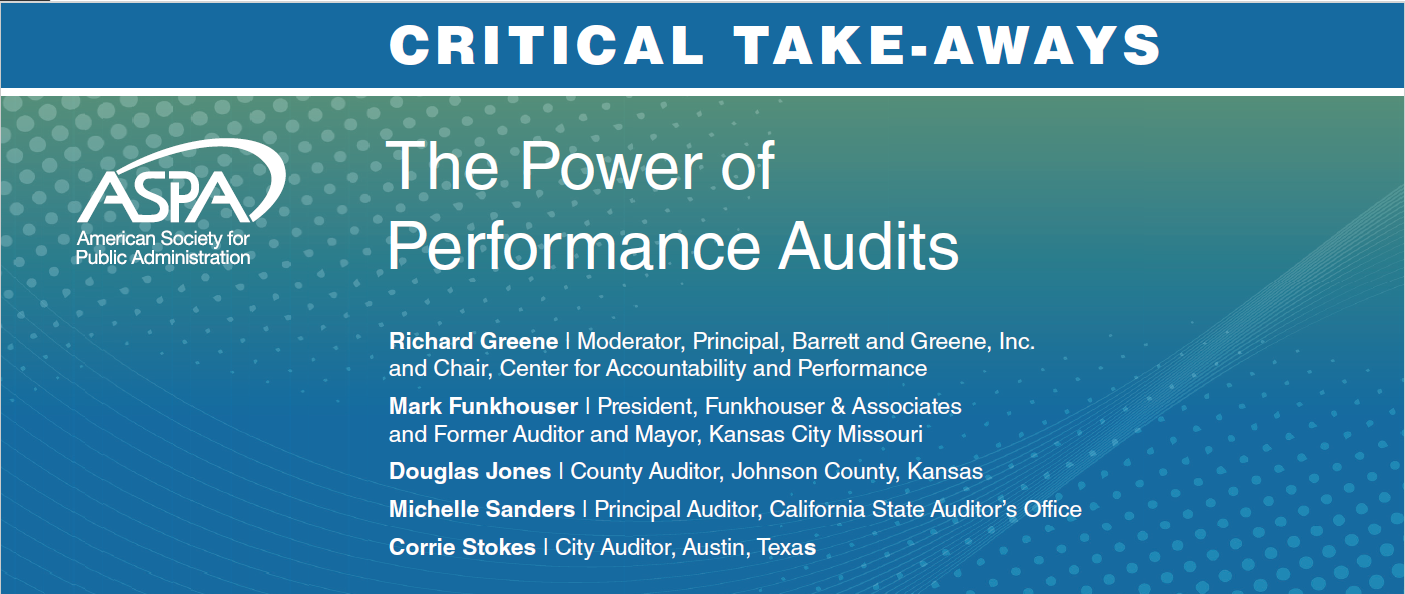 ASPA launched its publication series, Critical Take-Aways—designed to help practitioners, scholars and students stay informed and engaged on the most important issues for our profession—earlier this year. Each edition offers insights into a recent ASPA webinar: what it covered, why it matters and how it relates to the public service community. Whether you're familiar with the topic or looking to learn more, Critical Take-Aways offers a quick starting point and a link to the full webinar on ASPA's website.
Four programs are available now:
- The Power of Performance Audits
- Navigating the New Intergovernmental Relationship
- From the Heritage Foundation to the White House: Project 2025 in Practice
- Redefining Governance: How Project 2025 Impacts Institutions and Social Trust
More editions are headed to your inbox soon. Check out the details on our website now and make the most of these open resources.
New Member Orientation Showcases Services, Website Features
 ASPA recently held a new member orientation via Zoom to educate our newest members about the services we provide and demonstrate how best to use our website to access them. New or tenured member, anyone can make the most of this video resource! We're regularly updating our website with services, publications, products and member tools, so take a look and refresh your memory! Things we discussed during this orientation included:
- An overview of ASPA's services
- How to make the most of your account pages (whether you're a current member or not)
- How to access Public Administration Review behind its paywall (free via your ASPA membership)
- How to learn more about our Chapters and Sections, contact their leaders and add one to your membership—available any time!
- How to find current and prior webinars, and our new publication series, Critical Take-Aways
Your ASPA membership is mostly a digital experience (with the exception of the annual conference and any print publications you may receive), accessed through our website, newsletters, e-digests and other electronic products. Make sure you know how to access everything you need (and remove what you don't) to have the best member experience possible.
Contact us with any questions!
Voices of ASPA 2026
 Voices of ASPA 2026, an eight-video series showcasing individuals who shared their expertise at ASPA's 2026 Annual Conference, is fully released and published on the Barrett and Greene website. Each of these experts took a few minutes to chat about ASPA and public administration; we are grateful to them for their time and to Barrett and Greene for the efforts they have put into publishing the series.
Interviews include:
- Haldane Davies (Director, Virgin Islands Bureau of Economic Research)
- Josh Diosomito (Executive Director, PPIA)
- Ian Elliott (Senior Lecturer, University of Glasgow)
- Juliette Kayyem (Faculty Chair, Harvard University)
- Matt Leighninger (Head of Democracy Innovation, National Conference on Citizenship)
- Valerie Lemmie (Senior Advisor, State and Local Government, Kettering Foundation)
- Alysson Snow (Mayor, City of Lemon Grove, California)
- Debbie Trueblood (CEO, NIGP)
We hope you'll check them out!
In Memoriam: Akira Nakamura
 It is with sorrow that we share the news of the passing of Akira Nakamura, a distinguished Japanese public administration scholar and professor at Meiji University. He passed away peacefully on May 16 at a hospital near his residence in Tokyo, Japan, at the age of 85. He is survived by his wife and two sons.
An ASPA member since 2015, he was a member of the International Chapter, attended several annual conferences and served as international editor of Public Administration Review.
Nakamura devoted his lifetime to advancing public administration scholarship, higher education and international academic cooperation. During his long and distinguished career at Meiji University, he served with exceptional dedication in numerous leadership capacities, including distinguished professor, dean and vice president.
Beyond Japan, Nakamura made enduring contributions to the international public administration community. He served as vice president of the International Institute of Administrative Sciences and was chair of its program and research advisory committee. In recognition of his distinguished scholarly contributions, he became the first Japanese scholar to be appointed fellow of the National Academy of Public Administration. Nakamura also was a founding member and the first president of the Asian Association for Public Administration. Through his visionary leadership and tireless efforts, he played a pioneering role in strengthening Asian public administration's intellectual foundations and promoting international scholarly collaboration throughout the region and beyond.
Nakamura will be remembered not only for his outstanding scholarly achievements and institutional leadership, but also for his integrity, wisdom, collegiality, humility and unwavering commitment to the global public administration community. His passing represents an immense loss to academia and to all those who had the privilege of knowing and working with him over many decades.
Those wishing to convey condolences or messages to the bereaved may contact Professor Masao Kikuchi of Meiji University (a former student of Professor Nakamura).
Submit a Comment on OMB's New Grantmaking Rule
The Office of Management and Budget(OMB) has posted a new rule, "Regulation for Federal Financial Assistance," for which an open comment period is open through July 13. In short, as observed by Don Moynihan, "The White House [has] proposed new policies governing the federal funding of American science." The rule looks to move scientific decisions away from scientists and instead to political appointees. Should the rule move forward, appointees will decide what will and won't get funded, and will determine if funding should be revoked at any time.
There have been numerous articles about this rule since it was posted earlier this month (including this one from Inside Higher Ed). You can review any of those for myriad scientific organizations' determinations about this rule.
Now is the time for public comment. Click here to review information via Regulations.gov and submit your comment by the July 13 deadline.
APPAM Fall Research Conference Scholarships Available
The Bloomberg Center for Cities at Harvard University is pleased to offer five scholarships for early-career researchers or PhD students attending APPAM's Fall Research Conference, November 5-7, 2026 in Boston. Aligned with the Center’s mission to support research, teaching and field work on urban problem solving, this scholarship is intended for current PhD students and individuals who received their PhD in the last five years whose work addresses urban problem solving and city leadership, management and governance. The scholarship will provide travel funding to the conference and prioritizes scholars from countries underrepresented in the public policy analysis and management fields. All applications are due by July 10. Learn more and apply via the APPAM website.
IBM Releases New Report: Agile and Adaptive Leadership in the Public Sector
This report, from the IBM Center for The Business of Government, examines why agile approaches have become so urgent for public sector organizations, and what this change demands of the government workforce. Author Ines Mergel (University of Konstanz) explores agile leadership across several connected dimensions: the mindset required to lead in an adaptive fashion, the specific work practices that make agile teams function effectively and the organizational conditions that either support or undermine those teams. The report concludes with a set of actionable recommendations, and resources through which leaders can leverage agile techniques to drive change in government organizations.

New editions of PAR are released every other month; articles are posted online regularly between editions. Check out the following open source articles that have been posted to the website recently.
From Threat to Challenge: Addressing Resistance to Diversity Through Holistic Diversity Previews and Tools
Ines Jurcevic, Felix Danbold and Miguel M. Unzueta
Framing Decolonization: Case Study of the Pan-Canadian Framework on Clean Growth and Climate Change
River Doxtator, Jennifer Wallner and Lydia Zhou
How Democratic Backsliding Shapes the Entry, Non-Entry, and Waiting of Potential Civil Servants
Reut Marciano, Ilana Shpaizman and Sharon Gilad
Context, Mechanism, and Outcome: Explaining Gendered Administrative Burdens on Abortion Access in Italy
Debra Lanfranconi and Markus Hinterleitner
Tips, Resources and Updates
The History of Kermit the Frog, an American Icon
A beloved cultural icon who's bright green? Kermit the Frog is also quintessentially American.
Remote Work—not AI—Has Sidelined Recent College Graduates, Research Finds
An analysis of federal employment data, paired with a deep dive into the flexible work arrangements at one unnamed Fortune 500 tech company, reveals that companies are less likely to hire recent college grads into occupations that can be done remotely.
Fewer Americans Say Democracy Is Central to Country’s Identity, AP-NORC Poll Finds
As the U.S. prepares for an extravagant celebration of its founding principles, fewer Americans see their country as exceptional, a new poll finds.

In the News
 Today's headlines contain plenty of news coverage of some of our nation's most pressing public administration challenges. ASPA has curated some of the most important stories from recent weeks. If you have not seen these yet, make sure you read them now!
Infrastructure
Public Finance
Public Service
Most news related to federal workforce changes by the current administration are being reported in Federal Workforce in Turmoil. Contact us if you are not receiving that digest and want to.
Social Equity
Members and Notables in the News
Evergreen Chapter:
Letter: Kimsey Answers Call to Service
Juliette Kayyem:
Mullin Faces Backlash over "Naive or Dumb" Plan to Pull CBP from Blue-City Airports
Roseanne Mirabella and Malcolm Oliver:
Behind the Scenes, N.J.’s Public Workforce Delivers Every Day
Don Moynihan:
The Lie Behind the SCOTUS Attack on Democracy
New Jersey Chapter:
NJ ASPA Honors Ten Public Servants and Eight Graduate Students at Its 2026 Annual Awards Reception
Howard Risher:
Federal Reform Efforts Keep Repeating the Same Pattern. Tennessee Offers a Different Model
Steve Rolandi:
Long-time ASPA member and New York Metro Chapter leader Steve Rolandi recently was honored with the 2026 Arnold L. Steigman Excellence in Service and Teaching Award from the New York Academy for Public Administration (SAPA). Find more information about this award on the SAPA website.
|
|
|
|
Around Public Administration
Here are the most recent updates from across the profession. Did we miss you? Send us your news and we'll include it in the next round!
Upcoming Events:
-
2026 KAPA International and Summer Conference
Busan, South Korea | June 22-24
Theme: Technology, Growth, Balance: A New Leap Toward the Future of Public Administration
-
Seventh World Conference on Remedies to Racial and Ethnic Economic Inequality
University of Minnesota | August 3-5
Theme: Partnerships, Pathways and Pipelines: Cross-Sector and Interdisciplinary Collaborative Strategies for Human Prosperity
Registration is open
-
EGPA and Transatlantic Dialogue
Rome, Italy | August 24-27
Theme: Public Governance for the Common Good: Human Intelligence Serving the Global Community
-
2026 Combined SECoPA/NECoPA Event
Norfolk, Virginia | September 17-19
Theme: Two Regions, One Future: Shaping Governance, Policy and Public Management through Research, Education and Practice
Registration is open
-
ABFM 38th Annual Research Conference
George Washington University Student Center | September 24-27
Theme: Shared Challenges, Shared Resources: Managing Public Budgeting and Finance in a Multi-Level System
Registration is open
-
55th Annual ARNOVA Conference
Philadelphia | November 19-21
Theme: Igniting Civic Activism: Grassroots and Voluntary Action and Democracy
Calls for proposals, calls for nominations and other updates:
-
Call for Proposals: Journal of Health and Human Services Administration
The Journal of Health and Human Services Administration (JHHSA) invites submissions for a special symposium titled "Building Healthy Communities: The Nexus between Public Administration and Public Health." This symposium seeks articles that examine how public administration shapes the health of the public through policy design, governance, leadership and delivery of health and human services. We are particularly interested in locally grounded work that addresses practical challenges facing communities in urban, rural, tribal and other local settings, with attention to how administrative systems respond to social, economic, environmental and infrastructural conditions affecting population health. Submissions may include applied research, policy or administrative analyses, program evaluations and practice oriented reports that offer actionable insights for practitioners and decisionmakers in health departments, human services agencies and policy environments. Contributions should clearly articulate implications for practice and governance and may include recommendations for improving public systems, cross-sector collaboration and community outcomes. The symposium welcomes work that centers accountability, equity and effectiveness in advancing the capacity of public institutions to promote community health and well-being. Initial submissions are due June 15. Click here for more information.
-
Call for Nominations: ABFM Scholarly Engagement Award
ABFM's Scholarly Engagement Award recognizes outstanding public budgeting and/or finance scholarly engagement in the previous calendar year (CY 25). Scholarly engagement is defined, for the purpose of this award, as an intellectual endeavor with a commitment to improving or informing public practices. This should entail an effort or product of scholarship whose primary purpose is public and/or community service and the audience is public servants and practitioners. This award is open to all ABFM members in good standing at academic institutions including tenured or tenure track faculty, adjunct faculty, graduate students and teaching and research faculty and staff. Only products where there is clear authorship are eligible. The products of scholarly engagement can represent a variety of work including, but not limited to, advising or consulting projects, courses/seminars/workshops, databases, webtools, books or published workbooks, and white papers or reports. Nominations should be made for a single scholar for a specific product whose intended audience was practitioners. For collaborative works, the committee encourages nominations of individual members, but may choose to award the prize to multiple scholars for a single collaborative product. The nomination letter should include information on the scholar being nominated, their organization and contact information, an abbreviated CV and details of the scholarly engagement product. If the committee selects a recipient, the winner will be recognized at the awards luncheon at the 2026 ABFM conference and presented with a commemorative plaque. Nomination letters and associated materials should be sent as an attachment in an email (in a pdf file) by June 20 to committee chair Craig Maher.
Other awards also are open for nomination. Visit the ABFM website for all details, awards chairpeople and deadlines.
-
Call for Papers: Special Issue on Accounting for What Matters (Financial Accountability & Management)
Public sector organizations are navigating economic instability, climate crises, inequities and political pressures, often forced to balance financial sustainability with the equally vital goals of social sustainability and equity. This special issue invites research that rethinks public sector accounting and accountability, not only as tools for fiscal management but also as frameworks that foster inclusion, fairness, resilience and long-term public value. Editors welcome conceptual, empirical and comparative studies addressing how accounting can better embed social sustainability, manage value trade-offs, strengthen organizational resilience and challenge existing power dynamics. Case studies, longitudinal analyses and critical perspectives across diverse contexts (health care, education, social services, etc.) are encouraged. Click here for more information. Submissions are due June 30.
-
Call for Editors: Journal of Health and Human Services Administration
JHHSA is seeking to expand its editorial board. They are welcoming inquires for the following roles: managing editor, associate editor, social media editor and social media intern. Statements of interest are requested by August 15. They may be sent to: [email protected] and [email protected].
-
Call for Papers: Public Money & Management (PMM) Theme
For this theme issue the publishers are looking for disciplinary eclecticism. They seek contributions that bring together insights from several disciplines including law, social sciences, public management and the study of politics. Traditionally public management has not engaged in "constitutional’ conversations." However, the rise of what has been identified within the political landscape as "populism" calls for a cross-disciplinary perspective to understand whether, and how, it is impacting public management and administration. Contributions of 8,000-word research articles, 1,000-word debate pieces and 3,500-word new development articles are asked to consider, but are not limited to: are we facing the limits of traditional thinking in public management? Is there a problem, incipient or actual, facing public managers if they are becoming answerable to politicians (1) with a value set that is antagonistic to the values of public management (if such exist); (2) antagonistic to the liberal, law-based state; (3) who may be poised to break the law—or make decisions that are likely to be challenged in courts? What is "extremism"/populism? Do public managers observe/answer to a code that protects them against orders (short of law-breaking)? How far do existing doctrines of accountability accommodate answerability for extremist policies? What lessons could public managers learn from international and comparative perspectives from the rise of populism in different political systems and architectures? The publishers are seeking both conceptual and case examples to address the questions above. All submissions should follow the PMM author guidelines and be submitted via ScholarOne. Find more information online. All submissions are due October 1.
PA TIMES Online
 Here's a selection of current pieces on PA TIMES Online, covering a range of issues within the profession. We accept individual articles on a rolling basis; if you have a piece you think would fit our publication, submit it to [email protected] for consideration. (Please review our submission guidelines in advance!)
|
| |
|